Turning on a faucet and getting nothing is one of the more unsettling plumbing experiences a homeowner can have. Unlike a single clogged drain or a dripping fixture, a total loss of water affects every part of daily life at once, from showers and laundry to cooking and flushing toilets.
Before assuming the worst, it helps to work through a simple troubleshooting sequence. Many total water outages in Orlando trace back to something outside the home entirely, while others point to a specific valve or component that a homeowner can safely check in a few minutes.
Step 1: Check for a Citywide or Neighborhood Outage
The first thing to rule out is whether the problem is happening outside your home altogether.
- Check the OUC (Orlando Utilities Commission) outage map if your service is through the city.
- Check the Orange County Utilities outage map if your address falls under county water service.
- Call the utility's customer service line for a status update if the map does not show an active issue nearby.
Planned maintenance, a water main break, or emergency repair work in your area can all cause a temporary loss of water that has nothing to do with your home's plumbing.
Test a Neighbor's Spigot
A quick way to confirm a utility-side outage is to ask a neighbor to check their outdoor spigot. If their water is also out, the issue is almost certainly on the utility side, and a plumber cannot fix a problem that starts before the meter.
Step 2: Confirm It Really Is the Whole House
Before assuming every fixture is affected, check a few different locations around the home.
- Try both hot and cold water at more than one fixture.
- Check an outdoor hose bib in addition to indoor faucets.
- Note whether only hot water is missing, which usually points to a water heater problem rather than a true whole-house outage.
- Check whether an entire wing or level of the home is unaffected, which can point to a closed zone valve instead of a full outage.
If some fixtures still work, the problem is more likely local rather than a full loss of supply.
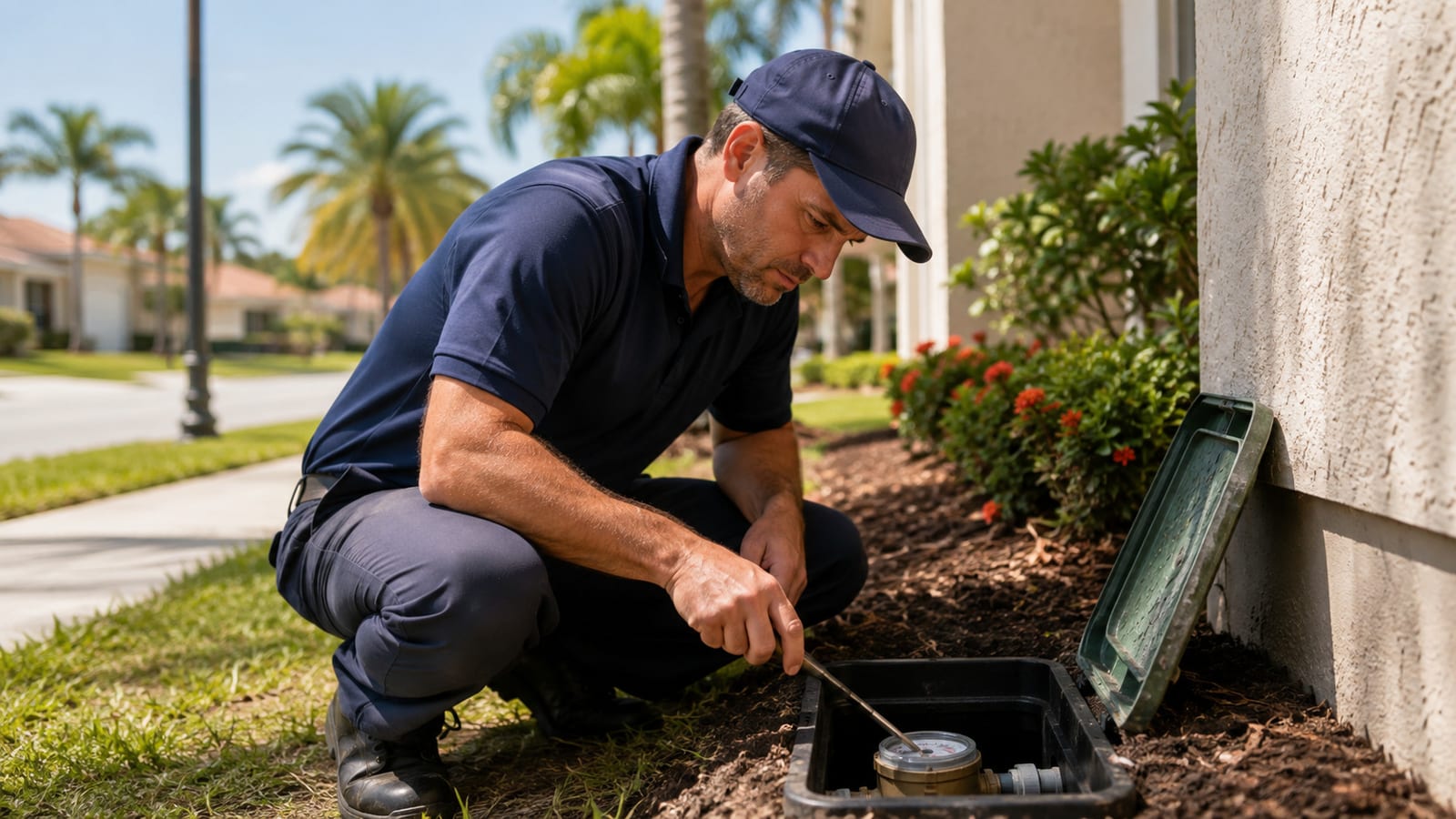
Step 3: Inspect the Curb Meter Box
Most Orlando homes have a water meter in an in-ground box near the sidewalk or property line.
- Locate the box and carefully lift the lid, watching for insects or debris inside.
- Watch the meter dial. Movement with everything in the house turned off can indicate a leak somewhere on the line.
- Look for standing water inside the box, which can point to a leak on either side of the meter.
The valve directly at the meter belongs to the utility and should not be adjusted by a homeowner. If it appears closed, that is a question for the utility rather than something to fix yourself.
Step 4: Locate and Check Your Main Shut-Off Valve
Every home also has a main shut-off valve where the water line enters the house, often near the garage, a hose bib, or an exterior wall.
- Confirm the valve is fully open. A quarter-turn ball valve should be parallel to the pipe when open.
- Check for signs the valve was recently touched, such as during landscaping, a remodel, pest treatment, or irrigation work.
- If the valve feels stuck, corroded, or will not turn, avoid forcing it.
An accidentally closed or partially closed main valve is one of the more common, and easiest to fix, causes of a sudden loss of water.
Step 5: Check the Pressure Reducing Valve
Many Central Florida homes have a pressure reducing valve, or PRV, installed where the water line enters the property. This valve protects the plumbing system from excessive municipal water pressure.
- A failed PRV can restrict water flow dramatically or block it entirely.
- The PRV is usually a bell-shaped valve located near the main shut-off, often in the garage or along an exterior wall.
- Sudden pressure loss without any visible leak can point to a PRV that has failed closed.
Because a PRV sits inline with the entire water supply, a failure here can feel identical to a total outage even though the rest of the plumbing system is fine.
Step 6: Rule Out a Failed Well Pump
Homes on well water, common in parts of unincorporated Orange County and the surrounding areas, rely on a pump rather than a municipal connection.
- Check the breaker for the well pump to confirm it has not tripped.
- Listen for the pump cycling on when a faucet is opened elsewhere in the home.
- Note any recent pressure tank issues, such as short cycling, chattering, or unusual noise before the water stopped completely.
A well pump that has failed will not respond to any of the steps above, since there is no municipal supply behind it to check.
Three Signs the Problem Is on Your Side of the Meter
After ruling out a utility outage, a few specific symptoms point clearly to a plumbing issue on your property rather than something the utility needs to fix.
- The meter dial keeps spinning even though every fixture in the house is off.
- The ground near the meter box or main line is wet, soft, or unusually green with no clear source.
- Water pressure or supply changed suddenly and recently after digging, landscaping, or construction work nearby.
Any one of these three signs usually means there is a break somewhere on your side of the meter, and the situation needs a same-day plumber rather than a wait-and-see approach.
No Water in Your Orlando Home Today?
A total loss of water is rarely something to ignore for long, especially once a utility outage has been ruled out. If your checklist points to a problem on your side of the meter, a stuck main valve, a failed PRV, or a well pump that will not respond, professional diagnosis can help restore water safely and quickly.
Working through each step calmly, in order, saves time and helps you describe the problem clearly when you do call for help, which makes for a faster and more accurate visit.